Alisander le Orphelin
Le Morte d'ArthurAlisander le Orphelin, the son of Boudwin and Anglides, enters the story through the violence that makes him an orphan in name and a fugitive in childhood. His mother escapes with him after King Mark treacherously kills Boudwin, and later gives him a bloody doublet on the day he is made a knight, together with a charge that connects his new status to the family history he has inherited. His adventures carry that history from private memory into the public tests of tournament and combat, before Morgan le Fay’s castle makes survival depend on another person’s intervention.
Identity and Family Background
Alisander is introduced as the young son of Boudwin, whom King Mark kills despite Boudwin’s good service. Anglides, Boudwin’s wife, escapes with her child and reaches the castle of Arundel. The chapter heading names Alisander in relation to this flight, placing his early identity under the sign of loss and escape rather than inheritance securely enjoyed.
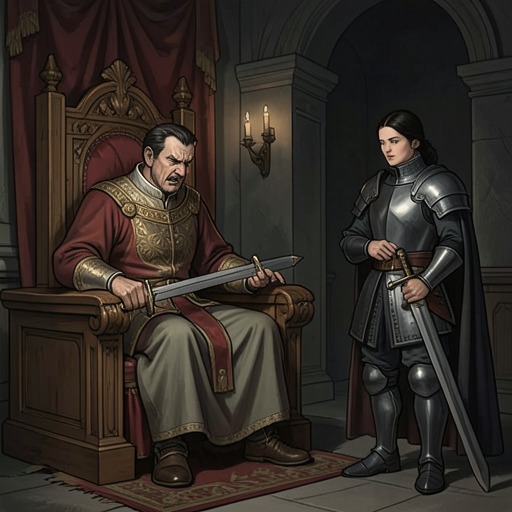
The evidence presents Anglides not merely as the parent who saves him but as the keeper of his family’s memory. On the day Alisander is made a knight, she gives him Boudwin’s bloody doublet and a charge with it. The garment makes his father’s fate a material part of his entry into knighthood: the new knight receives an object tied to the treachery that shaped his childhood, along with an instruction whose exact contents are not specified in the available account.
Knighthood and Public Recognition
Alisander’s knighting marks a change from the child carried to safety to an adult entering the public world of arms. His mother’s gift and charge accompany this transition, linking his personal advancement to the circumstances of Boudwin’s death without establishing what action Alisander takes in response.
At a tournament, Alisander wins the prize. The chapter heading also associates this success with Morgan le Fay and says that he fights Sir Malgrin and kills him. Thus the tournament episode moves beyond recognition through competition: Alisander’s prowess is followed by a lethal confrontation. The evidence supports his victory and Malgrin’s death, but gives no further detail here about the terms of their encounter or the prize itself.
Captivity and Escape
After the encounter, Morgan le Fay has Alisander in her castle and heals his wounds. The episode places him in her power, but the account does not specify the circumstances of his capture or the nature of his injuries. Her healing does not conclude the episode: Alisander is subsequently delivered from the queen by means of a damsel.
The damsel’s aid is the stated means of his release, making escape a collaborative turning point in his story. The chapter heading does not name her or explain how she accomplishes his deliverance. What it does establish is that Alisander’s passage out of Morgan’s castle depends not solely on his own force, but on help from someone within the episode.
Narrative Role and Significance
Alisander’s short sequence joins several recurring patterns in the wider chronicle: a child endangered by treachery, an upbringing away from the immediate danger, knighthood marked by a family relic, and public worth tested in combat. His mother’s preservation of Boudwin’s bloody doublet keeps the past present at the very moment Alisander assumes a new social identity. The later tournament, fight with Malgrin, and release from Morgan’s castle extend his career through both achievement and vulnerability.
His story also sits within a narrative preoccupied with concealed or disputed identity and the obligations of kinship. Elsewhere, the book describes Merlin’s arrangement for Arthur to be secretly raised by Sir Ector, and Arthur’s discovery that Ector is his foster father rather than his birth father. Alisander’s evidence is distinct: it establishes his parentage and his mother’s flight, not a secret royal lineage. The contrast places his family history among the book’s broader stories of separation, remembered origins, and the making of a knight.